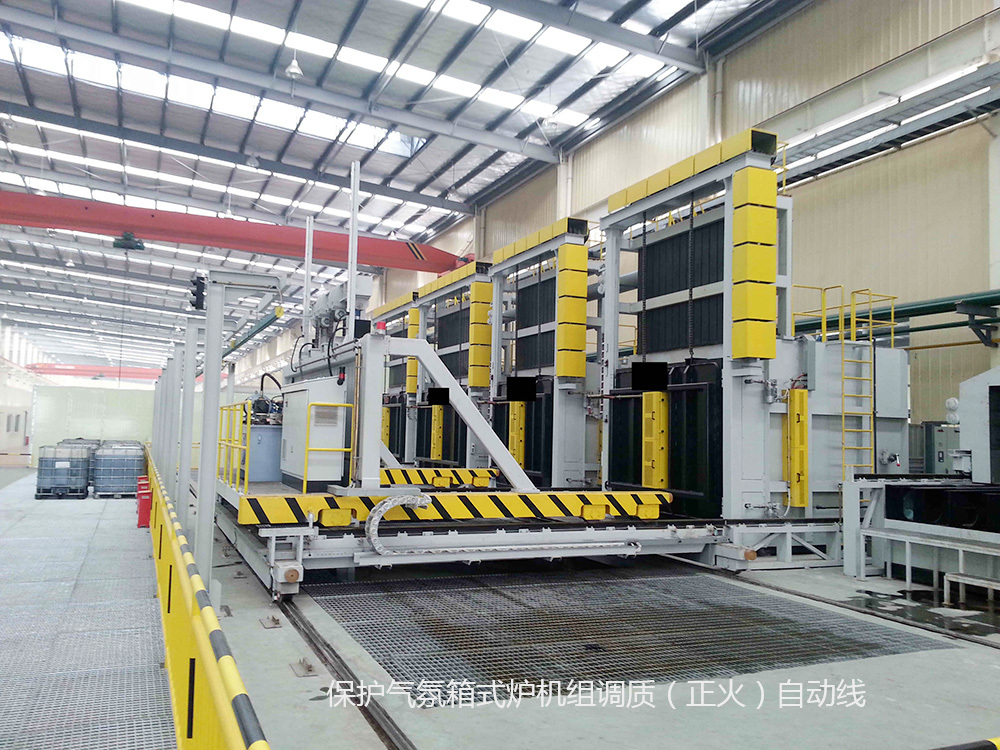
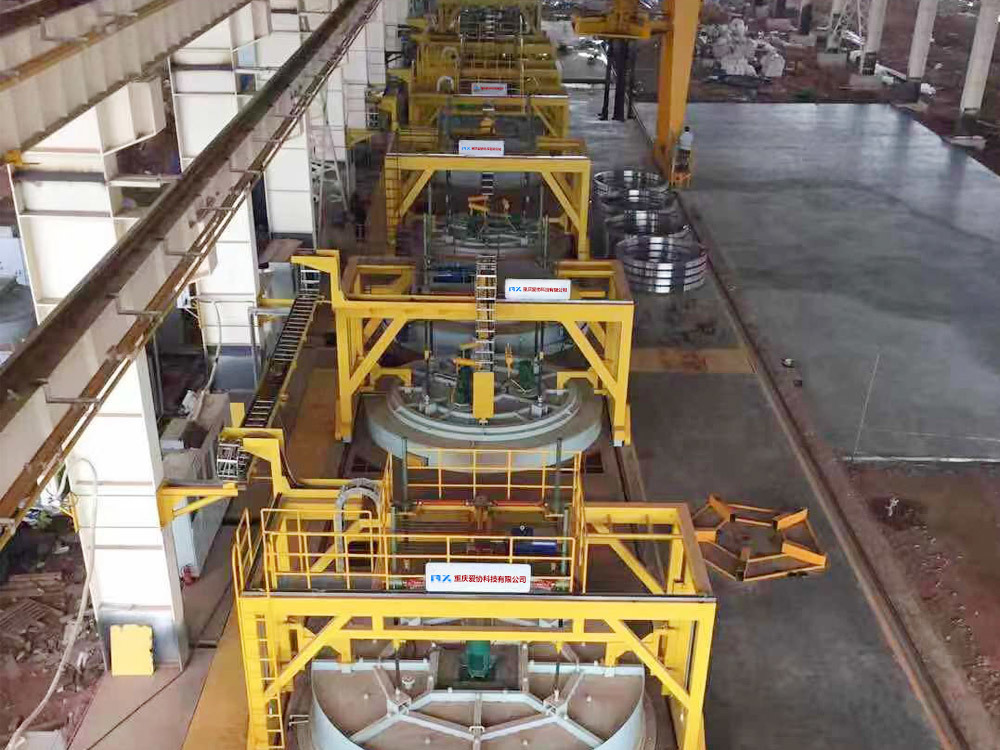
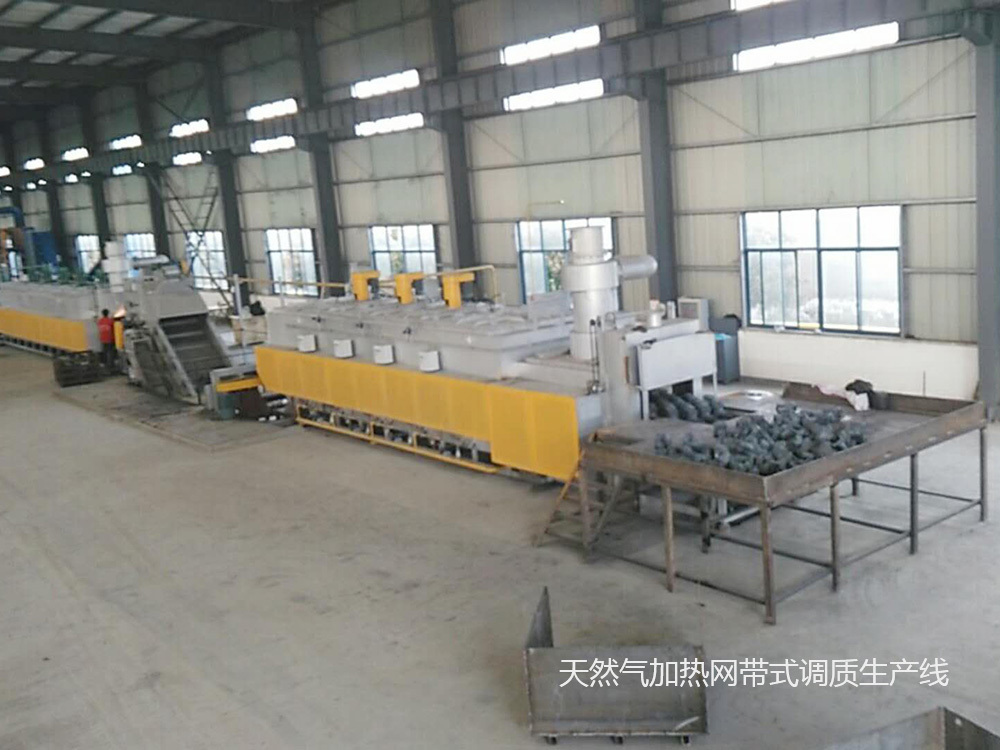
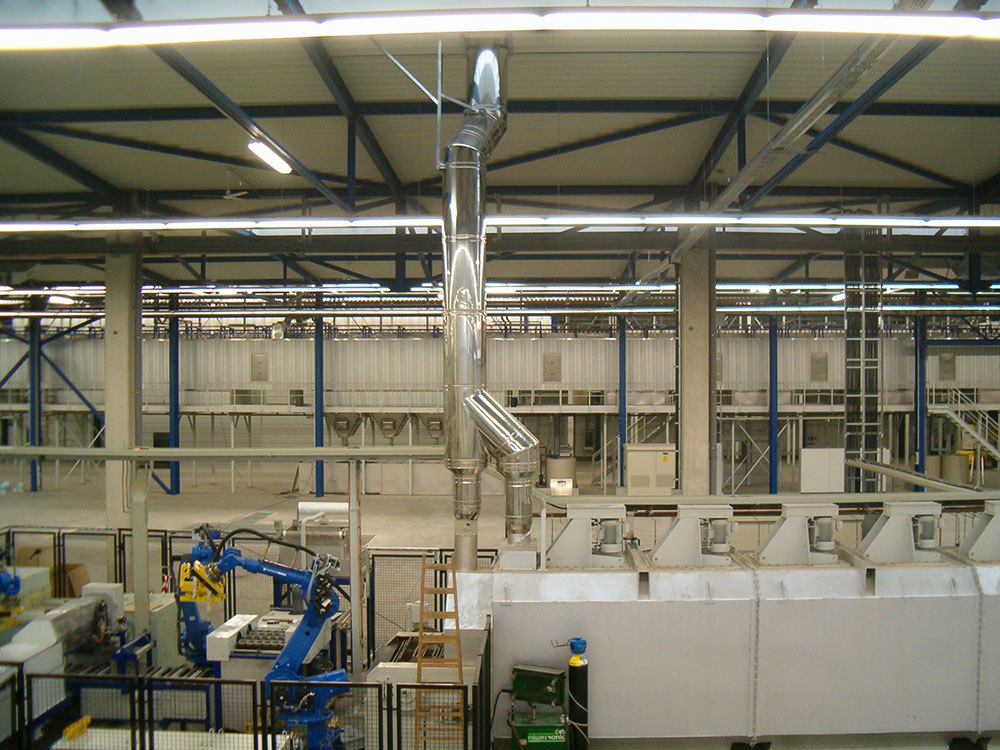
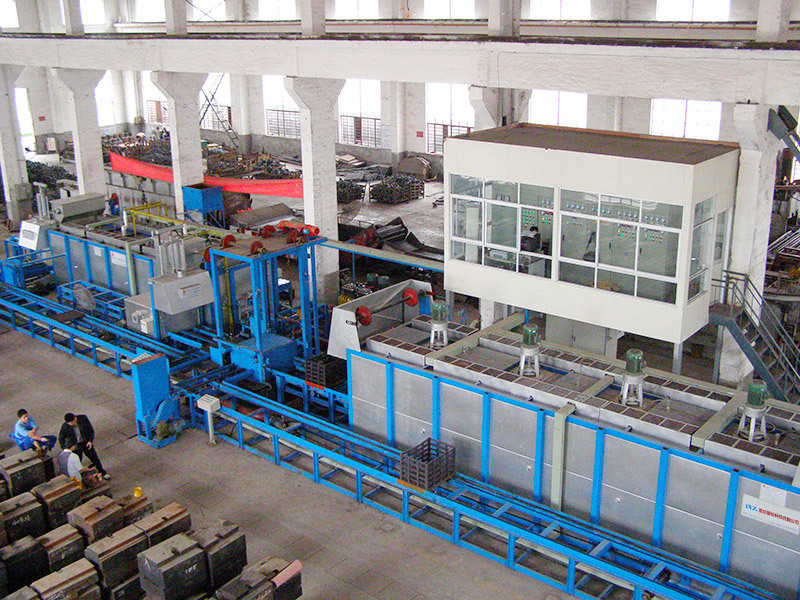
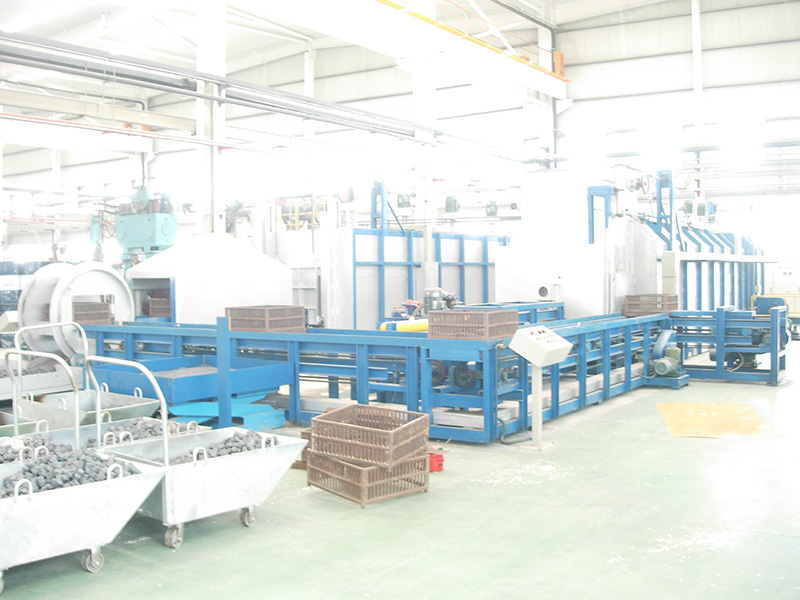
I. Purpose: Batch carburizing and tempering (normalizing) in a protective atmosphere (air) are used for various small- and medium-sized metal parts, such as standard fasteners, springs, and forged and cast automotive and motorcycle components including drive shafts, crankshafts, steering knuckles, track-link joints, connecting rods, etc. The applicable weight range is generally ≤30 kg per part.
II. Characteristics:
1. Overall Equipment:
1) The entire furnace “a” features a special design aimed at meeting the quality requirements for workpiece heat treatment and enhancing user flexibility in operation and use. It boasts adjustable mesh speed, adjustable coolant stirring speed, and features that help prevent environmental pollution.
2) To effectively reduce vibration, minimize noise, and prevent impacts: Metal mesh belts are installed on the surfaces of all material discharge ports and receiving plates.
3) The quenching furnace and tempering furnace are equipped with water circulation cooling systems for their stirring fans, each featuring a coolant level display device to prevent equipment damage caused by insufficient water supply in the pipelines. In the event of a coolant supply failure, the system can automatically switch over to a backup tap water source.
4) The mesh belt quenching furnace can use a protective atmosphere to prevent oxidation of the workpieces.
5) The entire production line features automatic control, is easy to operate, requires no multiple operators, and thus saves labor.
6) The system is controlled by an industrial PC, featuring a high degree of automation.
2. Quenching furnace:
1) Heating: Heating can be achieved using electric radiant tubes or natural gas radiant tubes, or alternatively by direct heating with gas burners. The system features PID control, PLC, and a touch-screen control interface. The system incorporates either self-preheating burners or high-speed burners that utilize heat exchangers to preheat the furnace air with waste heat from flue gases, resulting in high thermal energy utilization and low operating costs.
2) Transmission: A roller-type synchronous transmission is employed, ensuring minimal tension on the mesh belt during operation, preventing slippage, and providing a long service life.
3) Bearings: The drive-side roller bearings are high-temperature, large-clearance bearings, while the burner-side bearings are graphite self-lubricating bearings. This ensures a long service life and reduces equipment maintenance requirements.
4) Furnace Sealing: The preheating zone is equipped with three sealing curtains. A furnace door mechanism effectively minimizes heat loss from the furnace interior. Additionally, several partition walls are constructed at the bottom of the preheating zone. Near the quenching furnace’s discharge port, there are heat-shielding curtains and medium-sealing curtains that prevent quenching water vapor from entering the furnace chamber and compromising product quality.
5) Thermal Insulation: A specialized masonry technique featuring segmented and zone-specific construction is employed, ensuring that each zone operates as a relatively independent space and minimizing cross-flow of furnace gases among zones. This approach guarantees precise temperature control, stable temperature maintenance, and high insulation accuracy in each zone, thereby reducing energy consumption. The furnace roof insulation is constructed using a foldable design with high-temperature aluminosilicate refractory fiber needle-punched blankets, delivering significant energy-saving benefits while eliminating the drawback of traditional suspended insulation cotton easily falling off. This design also boasts an extended service life. The hot-side lining of the furnace uses lightweight insulating bricks, while the back lining is made of high-temperature sillimanite boards.
6) Automatic belt deviation correction device: A belt deviation correction device is installed at the belt inlet. When belt deviation is detected, the movable end of the automatic micro-adjustment roller will automatically adjust until the belt is properly aligned.
3. Quenching tank:
1) Impact Protection: The quenching furnace’s material hopper features a cushioning and sliding mechanism to prevent product damage from impacts and material jams.
2) Jetting: The design features a powerful jetting system. The quenching tank is equipped with a variable-frequency mechanical stirrer and a quenching medium circulation pump, ensuring ample coolant flow during production and enabling rapid removal of hot media from the quenching chute area.
3) Cooling: Equipped with a quenching medium cooling system, including a dedicated cooling pump and a high-efficiency stainless steel plate heat exchanger. When the quenching medium temperature exceeds the process-set value, the cooling pump automatically starts to perform heat exchange on the quenching medium, ensuring that the medium’s temperature remains within the specified process range and thus guaranteeing product quality.
4) Liquid Curtain: A specially designed liquid curtain sealing device equipped with a dedicated liquid curtain pump for liquid supply, which prevents quenching water vapor from entering the furnace and affecting product quality.
5) Filtration: A filter screen is installed upstream of the pump to prevent oxide scale from entering the circulation and cooling pipelines, thereby avoiding blockage of spray nozzles or heat exchangers.
6) Mixing device: Equipped with a variable-frequency motor for stirring, which adjusts the cooling rate according to the size of the workpiece, ensuring product quality.
4. Tempering furnace
1) Heating: Heating can be achieved using electric radiant tubes or natural gas radiant tubes, or alternatively by direct heating with gas burners. The system features PID control, PLC, and a touch-screen control interface. The system incorporates either self-preheating burners or high-speed burners that utilize heat exchangers to preheat the furnace air with waste heat from flue gases, resulting in high thermal energy utilization and low operating costs.
2) Furnace temperature uniformity: A high-power fan is used to force hot air circulation, ensuring uniform and consistent temperature throughout the furnace.
3) Transmission: The system employs a single-row roller synchronous transmission within the upper mesh belt furnace, ensuring minimal tension on the mesh belt during operation, preventing slippage, and extending its service life.
4) Water-cooling device in the discharge area after workpiece tempering: According to product process requirements, cool the tempered workpieces to prevent temper embrittlement.
5) Automatic web belt deviation correction device: A web belt deviation correction device is installed at the web belt inlet. When web belt deviation is detected, the movable end of the automatic micro-adjustment roller will automatically adjust until the web belt is properly aligned.
5. The production line is equipped with complete and reliable electrical automatic control, safety interlocks, and alarm functions.
6. The entire electrical system uses renowned and high-quality products, with key components sourced from imported brands.
7. All critical components—such as gas control elements, insulation materials, support rollers, mesh belts, fans, and circulation pumps—are sourced from well-known brands to ensure the quality of the production line.
III. Specifications and Technical Parameters of the Electric Heating Mesh Belt Normalizing (Annealing) Heat Treatment Line
|
Model
|
1AXWD-250
|
2AXWD-350
|
3AXWD-450
|
4AXWD-550
|
5AXWD-750
|
6AXWD-1000
|
7AXWD-1200
|
8AXWD-1500
|
|
Maximum output
|
250kg/h
|
350kg/h
|
450kg/h
|
550kg/h
|
750kg/h
|
1000kg/h
|
1200kg/h
|
1500kg/h
|
|
General production capacity
|
200kg/h
|
300kg/h
|
400kg/h
|
500kg/h
|
700kg/h
|
800kg/h
|
1000kg/h
|
1200kg/h
|
|
Heating furnace model
|
1AXWD9-40400
|
2AXWD9-50550
|
3AXWD9-60600
|
4AXWD9-80600
|
5AXWD9-80800
|
6AXWD9-801000
|
7AXWD9-1001000
|
6AXWD9-1201200
|
|
Heating furnace mesh belt width
|
400
|
500
|
600
|
800
|
800
|
800
|
1000
|
1200
|
|
Heating furnace length
|
4000
|
5500
|
6000
|
6000
|
8000
|
10000
|
10000
|
12000
|
|
Heating furnace inlet end length
|
2000
|
2000
|
2000
|
2000
|
2000
|
2000
|
2000
|
2000
|
|
Heating furnace preheating length
|
1500
|
1500
|
1500
|
1500
|
1500
|
1500
|
1500
|
1500
|
|
High import workload
|
100–150
|
100–150
|
100–200
|
100–200
|
100–200
|
100–250
|
100–250
|
100–300
|
|
Electric heating power
|
90kw
|
135kw
|
180kw
|
240kw
|
300kw
|
360kw
|
420kw
|
480kw
|
| Natural gas heating capacity |
/ |
/ |
480kw |
600kw |
780kw |
960kw |
1110kw |
1260kw |
|
Quenching tank empty volume
|
~5 m³
|
~8 m³
|
~10 m³
|
~12 m³
|
~15 m³
|
~20 m³
|
~30 m³
|
~30 m³
|
|
Tempering furnace model
|
1AXWD7-60600
|
2AXWD7-70750
|
3AXWD7-80800
|
4AXWD7-100800
|
5AXWD7-1001000
|
6AXWD7-1001200
|
6AXWD7-1201200
|
6AXWD7-1201200
|
|
Annealing furnace mesh belt width
|
600
|
700
|
800
|
1000
|
1000
|
1000
|
1200
|
1200
|
|
Tempering furnace length
|
6000
|
7500
|
8000
|
8000
|
10000
|
12000
|
12000
|
12000
|
|
Quenching furnace inlet length
|
1500
|
1500
|
1500
|
1500
|
1500
|
1500
|
1500
|
1500
|
|
Induction heating power for tempering
|
75 kw
|
105 kw
|
135 kw
|
180 kw
|
235 kw
|
270 kw
|
320 kw
|
360 kw
|
| Natural gas heating capacity |
/ |
/ |
270kw |
360kw |
480kw |
600kw |
780kw |
960kw |